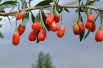









The Himalayan goji begins to fruit from its 2nd year, the small purple bell-shaped flowers appear continuously from June to September, they are bisexual and self-fertile, but cross-pollination with another subject nearby promotes quantity yield its small orange berries with pulpy flesh. The harvest of Himalayan goji berries takes place from the end of August until autumn, after picking, they can be consumed fresh, but generally, they are better appreciated dried, in this case, these miraculous little fruits are put to dry in a dry, well-ventilated place then stored in a jar to be consumed throughout the winter.
Description
The Himalayan goji is also called lyciet or Lycium barbarum by botanists in reference to Lycia, an ancient kingdom of Asia Minor. In this region, berries have been consumed for more than 3000 years, certain peoples consume lyciet berries on a daily basis, very rich in antioxidants among other things, their life expectancy is thought to far exceed 100 years, the secret of their exceptional longevity being held.
In our regions, being very hardy (beyond -20°C) the Himalayan goji adapts well, it is a small, undemanding shrub, 3 by 3 meters, to be grown in a pot or in the ground, in the garden, in a sunny place. Although it can get by in poor soil, it thrives much better in rich, moist, slightly acidic, but well-drained soil.
The Himalayan goji begins to fruit from its 2nd year, the small purple bell-shaped flowers appear continuously from June to September, they are bisexual and self-fertile, but cross-pollination with another subject nearby promotes quantity yield its small orange berries with pulpy flesh. The harvest of Himalayan goji berries takes place from the end of August until autumn, after picking, they can be consumed fresh, but generally, they are better appreciated dried, in this case, these miraculous little fruits are put to dry in a dry, well-ventilated place then stored in a jar to be consumed throughout the winter.
The growth of the Himalayan goji is quite rapid, it accepts being pruned without problem after fruiting.
Shipping & delivery
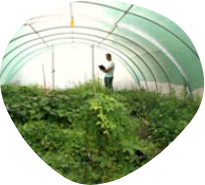 As soon as you place your order your plants are selected
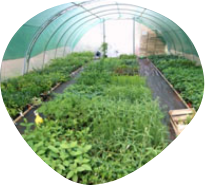 Each order is processed individually.
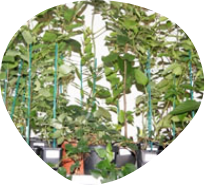 Plants are packed, staked and labeled.
 Packaging is carefully implemented to avoid any problems.
 Packages are ready to be shipped.
Expédition de nos plantes dans toute l'Europe (sauf en outre mer et les îles).
Avis clients
Great condition!
I am very happy with this plant and its packaging. It's a very healthy plant.


The Himalayan goji begins to fruit from its 2nd year, the small purple bell-shaped flowers appear continuously from June to September, they are bisexual and self-fertile, but cross-pollination with another subject nearby promotes quantity yield its small orange berries with pulpy flesh. The harvest of Himalayan goji berries takes place from the end of August until autumn, after picking, they can be consumed fresh, but generally, they are better appreciated dried, in this case, these miraculous little fruits are put to dry in a dry, well-ventilated place then stored in a jar to be consumed throughout the winter.
Your cart is empty
Continue shopping