- Out of stock




The Strawberry Tree Hannie, a compact variety perfect for small spaces. This magnificent evergreen shrub will seduce you with its simultaneous flowering and edible red fruits in autumn. Hardy and decorative all year round, ideal in pots or sunny beds.
Description
The Arbutus unedo 'Hannie' is a true plant jewel for small gardens and terraces, distinguishing itself from the type species by its remarkable compactness. This evergreen shrub offers a rare and magical spectacle in autumn: it bears its flowers and fruits simultaneously, creating a striking contrast between the white of the bells and the bright red of the strawberry-like fruits. Its modest size and slower growth make it the ideal candidate for growing in large containers or for structuring low borders without ever becoming invasive. Besides its undeniable decorative aspect, it is a valuable plant for late biodiversity, offering nectar to the last pollinators of the season. Its bark, which exfoliates with age, adds an extra graphic touch in winter. The Strawberry Tree Hannie embodies the essence of Mediterranean flora adapted to restricted spaces, bringing a touch of warmth and evergreen presence all year round. It is an aesthetic, ecological, and gourmet choice that transforms an ordinary garden corner into a lively and colourful scene.
The species Arbutus unedo is native to the Mediterranean basin and the Atlantic coast of Europe, up to Ireland. The cultivar 'Hannie' is a modern horticultural selection, specifically isolated for its dwarf habit and superior foliage density.
It belongs to the Ericaceae family. This is a family of often acid-loving plants which also includes heathers (Erica), rhododendrons, and blueberries, sharing with them the characteristic shape of their bell flowers and sometimes similar cultural needs.
The Strawberry Tree is a pyrophyte plant, capable of regenerating naturally after a fire. The 'Hannie' variety is distinguished by often more abundant fruiting relative to its reduced size. It is an ornamental fruit tree whose fruit maturation cycle lasts exactly one year, explaining the simultaneous presence of the current year's flowers and the previous year's fruits.
Unlike the wild species which can become a tree, the 'Hannie' cultivar retains modest dimensions, reaching an adult height between 1.50 m and 2 metres. This reduced stature allows it to be easily integrated into small spaces or rockeries without requiring drastic pruning to limit its volume.
This shrub presents beautiful density and spreads over a width of about 0.75 m to 1 metre. Its limited ground footprint makes it an ideal plant for low alignments or container growing on a balcony, where space is often limited and precious.
The Arbutus unedo 'Hannie' is characterized by a compact and dense round habit. It naturally forms a regular and well-filled ball from the base, not becoming bare with time, which gives it a neat and architectural look without major maintenance effort from the gardener.
The trunk and main branches display a very decorative reddish-brown bark which has the particularity of exfoliating in fine strips (peeling). This phenomenon reveals lighter and orange tints underneath, offering a graphic visual interest, particularly appreciable in winter when the light is low.
The foliage is evergreen and leathery, composed of oval leaves, serrated on the edges and glossy dark green. They remain attractive all year round, offering a permanent green background that highlights autumn flowering and fruiting. Young shoots can sometimes be tinged with bronze.
The 'Hannie' variety has a slower growth than the species. This slowness is an asset for the gardener, as it significantly reduces pruning needs and allows the plant to maintain its compact shape durably without becoming untidy or invading its neighbours.
Although of Mediterranean origin, this shrub shows good cold resistance, tolerating temperatures of -10 to -12 °C in drained soil. In very cold regions, winter protection (fleece) or growing in a sheltered pot is recommended to preserve foliage and fruiting.
The flowering is autumnal and occurs mainly from October to November. It is a valuable period when few shrubs are in bloom, allowing the Strawberry Tree 'Hannie' to become the focal point of the garden as winter approaches, animating the space before the great cold.
The flowers appear in the form of drooping panicles composed of small bells (urceolate) of a creamy white to pinkish colour. They look very much like lily-of-the-valley flowers and release a light honey scent that attracts insects still active at this season.
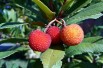
The fruits, called arbutus berries, are spherical berries with a rough surface, turning from yellow to bright red at maturity. Edible, they have a mealy and sweet flesh, rich in vitamin C. The particularity is the simultaneity of flowers and fruits: this autumn's flowers will yield next autumn's fruits.
It is a highly melliferous plant at the end of the season, providing one of the last sources of nectar for bees and bumblebees before winter. The red fruits are also highly appreciated by birds, notably thrushes and blackbirds, which participate in seed dispersal.
The Strawberry Tree 'Hannie' requires a sunny and warm exposure to fruit well. It tolerates light partial shade, but direct sun favours a denser habit and more intense fruit colouring. It must imperatively be sheltered from cold and drying winds.
It prefers a well-drained, light, and humus-rich soil. Although it tolerates slight limestone (unlike other Ericaceae), it flourishes better in soil with an acidic or neutral tendency, rich in silica. It fears stagnant moisture at the roots.
It is crucial to ensure perfect drainage. Loosen the soil deeply and incorporate river sand or gravel if your soil is heavy. Add leaf mould or ericaceous compost to slightly acidify the medium and lighten the texture.
To create a small hedge or grouped bed, respect a spacing of about 80 cm to 1 metre between each plant. This allows each plant to receive sufficient light while creating a compact mass effect once adult.
The soil should ideally be sandy or stony in nature, filtering water well. Soil that is too clayey or compact risks causing root asphyxiation and reducing the plant's cold resistance, compromising its future development.
Hydrate the rootball well before planting. Dig a hole twice as large as the root volume. Place the shrub without burying the root collar. Backfill with the prepared draining mixture, tamp gently by hand and water generously to remove air pockets around the roots.
Regular but not excessive watering is necessary the first year to encourage rooting. The soil should dry slightly on the surface between waterings. In pots, vigilance must be increased as the substrate dries faster.
Once well established (after 2-3 years), the Arbutus unedo is a plant resistant to summer drought. However, for beautiful fleshy fruits, occasional watering in summer during high heat is beneficial to support the plant.
Pruning should remain light and is not systematic. It is carried out in spring (March-April) to remove dead wood, damaged branches or to rebalance the silhouette if necessary. Avoid pruning in autumn so as not to sacrifice flowering and fruits.
Propagation of the Strawberry Tree is quite delicate. It can be done by sowing seeds stratified in the cold or by semi-ripe cuttings at the end of summer under cover. Layering is also a possible but long method to obtain new specimens.
Thanks to its reduced size, 'Hannie' is perfect in a container on a terrace, isolated in a rockery, or in an unpruned low hedge. It integrates wonderfully into seaside gardens or dry Mediterranean-style gardens.
Associate it with other Mediterranean plants like Cistus, Lavenders, Rosemary or sun-tolerant ericaceous shrubs like Pieris. The contrast of grey and green foliage will highlight its red fruits.
The fruit of the strawberry tree is edible and has been used since antiquity to make jams, jellies or liqueurs (like aguardente in Portugal). Its wood, hard and dense, was formerly highly sought after for making high-quality charcoal.
The Strawberry Tree can be subject to septoria leaf spot, a fungus that causes small brown spots edged with red on the leaves. Aphids can sometimes attack young shoots in spring, but this is generally not serious for the tree's survival.
To prevent fungal diseases, never wet the foliage when watering and ensure good air circulation. In case of septoria attack, treatment with Bordeaux mixture. Promote biodiversity to regulate aphids.
Mulch the base with pine bark to maintain slight acidity and soil coolness. An application of organic fertiliser special for "acid-loving plants" in spring will support growth and fruiting without burning sensitive roots.
The cultivar 'Hannie' differs clearly from the type species by its dwarf size (not exceeding 2 m) and its naturally very compact habit. Where the classic strawberry tree forms a tree with a bare trunk, 'Hannie' remains a dense bush. Its fruiting is often earlier and its fruits are particularly numerous relative to the plant's volume.
The Strawberry Tree Hannie (Arbutus unedo 'Hannie') is a compact evergreen shrub ideal for small gardens and terraces. Appreciated for its dense dark green foliage and its dual autumn attraction, it offers white flowering attractive to bees together with edible red fruits (arbutus berries) from October to November. With slow growth, it reaches 1.50 m to 2 m in height, naturally forming a decorative ball. Hardy down to -12°C, it resists drought once established. Its beautiful exfoliating bark and adaptation to pot culture make it an essential ornamental plant to bring life and colour to the garden in the late season.
Shipping & delivery
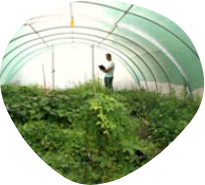 As soon as you place your order your plants are selected
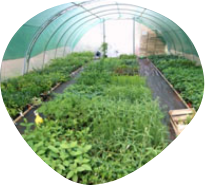 Each order is processed individually.
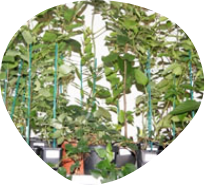 Plants are packed, staked and labeled.
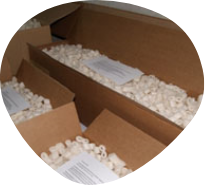 Packaging is carefully implemented to avoid any problems.
 Packages are ready to be shipped.
We ship our plants throughout Europe (excluding overseas territories and islands).
Avis clients


The Strawberry Tree Hannie, a compact variety perfect for small spaces. This magnificent evergreen shrub will seduce you with its simultaneous flowering and edible red fruits in autumn. Hardy and decorative all year round, ideal in pots or sunny beds.
Your cart is empty
Continue shopping