- New
- Pickup at nursery



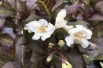
A black-and-white contrast shrub, Weigelia Black and White® has a compact habit, nectar-rich bloom and dark foliage flushing purple. Hardy and versatile, it suits small gardens, borders, beds and terraces in containers.
Description
The Dwarf Weigelia Black and White® is a deciduous shrub remarkable for the striking contrast between its dark foliage and bright white flowers. Selected by INRAE in Angers, this compact and original cultivar was awarded a bronze medal at the “PLANTARIUM 2009” fair in Boskoop, Netherlands. It stands out for its very short internodes, which give it a dense and harmonious silhouette. Its reduced size makes it an ideal choice for small gardens, borders or container planting. The dark green foliage gradually takes on purplish tones throughout the seasons, offering lasting ornamental interest. Flowering occurs in May and June, lighting up the branch tips with clusters of pure white trumpet-shaped flowers whose slightly tapered purplish-red base subtly echoes the colour of young leaves. This black-and-white contrast, rare among weigelias, gives the plant a modern and refined elegance. In addition to its aesthetic appeal, this cultivar is hardy down to -20 °C, making it suitable for many regions. Its moderate growth and compact habit make it easy to maintain and to integrate into varied plant compositions. It also attracts pollinators, contributing to garden biodiversity. In summary, the Weigela Black and White® is a decorative, robust and ecological shrub that enhances green spaces with its originality and ease of cultivation.
When and how to prune: Prune after flowering to preserve next year’s buds; cut back spent shoots to 2–3 nodes above a branching point, and thin out 1/4 of old wood every 2–3 years to renew flowering and maintain the compact habit.
Possible propagation methods: Semi-hardwood cuttings in summer in a draining, moist substrate under cover; layering of a low branch, pinned and slightly notched, then separated the following season; hardwood cuttings possible in late winter for experienced gardeners.
Possible sensitivities (diseases and pests): Generally robust; possible aphids on young shoots, powdery mildew in humid, crowded conditions, chlorosis in calcareous soil.
Prevention and natural treatments: Promote good air circulation, avoid excess nitrogen, mulch; for aphids, use black soap; prevent powdery mildew by adequate spacing and horsetail decoction sprays; correct chlorosis with iron amendments.
Practical advice for optimal growth: Provide sufficient light for generous flowering; maintain a drained and amended soil; prune lightly after flowering to stimulate branching; combine with contrasting perennials; in containers, renew the substrate every 2–3 years and monitor watering.
The Black and White® 'Courtacad1' stands out with its naturally dwarf and dense habit, short internodes and striking contrast between dark foliage and white flowers. Compared to classic pink-flowered weigelias, it offers a distinctive monochrome palette ideal for graphical compositions. Its compactness reduces maintenance, its nectar production enhances biodiversity, and its reliable hardiness ensures success in varied climates.
The Weigelia Black and White® 'Courtacad1' enhances small spaces with its compact habit and bright flowering. Easy and hardy, it adapts to well-drained soils and sunny to partially shaded exposures. Its bee-friendly nature attracts pollinators, supporting active biodiversity. Ideal for containers, borders and mixed beds, it pairs beautifully with lavenders, hardy geraniums and heucheras to reinforce the strong contrast. Low maintenance: light pruning after flowering and mulching. A reliable choice for a graphic and lively garden.
Shipping & delivery
 As soon as you place your order your plants are selected
 Each order is processed individually.
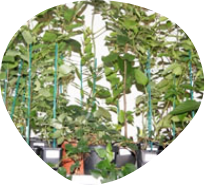 Plants are packed, staked and labeled.
 Packaging is carefully implemented to avoid any problems.
 Packages are ready to be shipped.
We ship our plants throughout Europe (excluding overseas territories and islands).
Avis clients


A black-and-white contrast shrub, Weigelia Black and White® has a compact habit, nectar-rich bloom and dark foliage flushing purple. Hardy and versatile, it suits small gardens, borders, beds and terraces in containers.
Your cart is empty
Continue shopping