- New




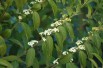
The Beautyberry 'Magical Snowqueen' illuminates the winter garden. Its clusters of pure white berries follow superb autumn foliage. Hardy and decorative, it is ideal in borders or for floral bouquets.
Description
The Beautyberry 'Magical Snowqueen' (or Callicarpa bodinieri) is a botanical marvel that reinvents winter scenery. While the majority of Callicarpa are known for their electric purple berries, this unique cultivar stands out with fruiting of a radiant pure white, reminiscent of snow pearls or sugar plums. Its main interest lies in its ability to illuminate shady corners and provide strong visual structure when the garden goes dormant in winter.
It is a deciduous shrub that offers a two-act show: blazing autumn foliage turning yellow and orange, followed by leaf drop revealing compact clusters of white berries persisting deep into winter. It is indispensable for floral art enthusiasts; its bare branches laden with fruit are sublime in bouquets. Hardy, easy-going, and disease-resistant, 'Magical Snowqueen' is an ideal structural plant for shrub borders, bringing a touch of magic and light where greyness usually dominates.
The type species Callicarpa bodinieri originates from the forests and mountain thickets of Central and Western China, as well as Vietnam. The 'Magical Snowqueen' cultivar is a recent horticultural selection, resulting from breeding work aimed at obtaining larger, more numerous white fruits that persist longer than on wild varieties.
It belongs to the Lamiaceae family (formerly classified in Verbenaceae). This is a vast family that includes many aromatic plants (mints, sages) and ornamentals. Plants in this family are often characterized by square stems and essential oils, although Callicarpa is grown mainly for the aesthetics of its fruits.
The name Callicarpa comes from the Greek kallos (beauty) and karpos (fruit), literally meaning "beautiful fruit". 'Magical Snowqueen' is special because it is a stabilized albino form. Unlike purple varieties that absorb light, its white berries reflect it, making it particularly valuable for brightening dark areas of the garden in autumn and winter.
'Magical Snowqueen' is a shrub of moderate size, perfectly adapted to both small and large gardens. At full maturity, generally after 5 to 7 years, it reaches a height between 1.50 meters and 1.75 meters. This human scale allows full enjoyment of its fruits at eye level without requiring a ladder for maintenance.
This shrub presents harmonious growth with a width roughly equal to its height, about 1.50 meters in span. It tends to bush out generously at the base, forming a dense bush that occupies space well without becoming invasive to neighbouring plants.
The habit is naturally bushy and upright in its youth. With age, and especially under the spectacular weight of autumn fruiting, the flexible twigs tend to arch gracefully outwards. This gives it a very elegant fan or fountain-like silhouette, which remains structured even without foliage.
Young twigs are initially slightly downy, before becoming smooth and taking on a fairly neutral grey-brown hue. The bark of older branches is marked by light lenticels (small pores), giving the wood a textured look. This neutrality of the bark is an asset as it serves as a discreet background to highlight the sparkle of the white pearls in winter.
The foliage is deciduous, composed of opposite, lanceolate, and elliptical leaves, measuring 5 to 12 cm long. Bright matte green during the summer season, they ignite in autumn, taking on golden yellow, orange, or even purplish hues. This autumn colouring creates a striking contrast with the white berries that begin to ripen simultaneously.
The Callicarpa has a medium growth rate. It does not grow explosively, which facilitates management, but it establishes itself quickly enough to offer a beautiful decorative effect from the second or third year after planting. It regularly produces new flowering wood each season.
It is a perfectly hardy shrub in our temperate climates. It withstands temperatures down to -24°C without special protection once well-rooted. However, young, freshly planted specimens can benefit from mulching at the base during their first winter to protect the root system.
Flowering occurs in summer, usually in June and July. It is relatively discreet and often goes unnoticed amidst the dense foliage, but it is essential as it prepares the abundant future fruiting. It appears on the current year's wood, hence the importance of pruning.
The flowers are tiny, gathered in axillary cymes (small clusters at the leaf axils). They are a white colour, with long protruding yellow stamens. Although modest compared to the fruits, they possess a charming delicacy if observed closely and are very numerous on the twigs.
The fruits are small round and shiny drupes of 3 to 4 mm in diameter, grouped in tight clusters along the stems. The 'Magical Snowqueen' variety produces berries of an immaculate ivory white. Inedible for humans (bitter and astringent), they persist on the shrub well after leaf fall, often until December or January. Although partially self-fertile, planting several specimens favours cross-pollination and thus more spectacular fruiting.
The summer flowers are melliferous and attract bees as well as butterflies. In winter, the berries represent a supplementary food source for certain birds (blackbirds, thrushes) when other food sources become scarce. However, birds often ignore them at the beginning of winter, allowing enjoyment of their decorative beauty for a very long time.
To guarantee abundant fruiting, Callicarpa needs light. A sunny or partial shade exposure is ideal. Full sun favors the density of fruit clusters, while too dense shade will tend to make the plant leggy and considerably reduce berry production.
It likes rich, deep, and well-drained soils. It prefers cool earth that does not dry out excessively in summer. Regarding pH, it is quite tolerant but shows a preference for neutral to slightly acidic soils, and dreads excessively calcareous soils which can cause chlorosis (yellowing of leaves).
It is crucial to loosen the soil to a depth of 40 to 50 cm. If your earth is heavy or clayey, incorporate river sand or gravel to improve drainage. Mix the extracted earth with quality planting soil and a little well-rotted compost to provide necessary nutrients for starting.
For a loose hedge or grouped bed (recommended for pollination), space the plants 80 cm to 1 meter apart. If you plant 'Magical Snowqueen' as a solitary specimen to make a plant sculpture, leave at least 1.50 meters of empty space around it so it can deploy its arched branches.
The soil must remain cool (slightly moist) especially the first few years. Avoid areas where water stagnates in winter, as excess moisture at the roots during dormancy can be fatal or promote root rot.
Immerse the pot in a bucket of water until bubbles stop appearing. Place the root ball in the hole so that the top of the root ball is flush with the natural ground level. Backfill, tamp moderately with your foot to remove air pockets, and form a watering basin around the trunk.
Copious watering (about 10 to 15 liters) is indispensable immediately after planting to settle the soil. During the first year, water regularly, about once a week from spring to autumn, to ensure good establishment, especially if the summer is dry.
Once established, the Beautyberry is relatively resistant. However, to obtain beautiful fleshy berries that do not wrinkle prematurely, it is advisable to keep the soil cool in summer by occasional watering during heatwaves and by applying an organic mulch (bark, dead leaves) at its base.
Pruning is ideally done in late winter (March), before vegetation starts. Since Callicarpa flowers and fruits on the year's wood (new shoots), do not hesitate to cut back old branches severely by two-thirds of their length. This stimulates the production of vigorous young twigs that will bear the most beautiful clusters of white fruits the following winter. Remove dead wood and puny branches in the center to aerate the clump.
The most faithful method to reproduce the 'Magical Snowqueen' cultivar is cuttings. Softwood cuttings are taken in June or semi-ripe cuttings in late summer (August-September). Sowing is possible but unpredictable for cultivars, as offspring may not retain the exact characteristics of the mother plant (notably the pure white color).
Place it in a strategic spot, visible from the house windows, to enjoy its berries in winter. It is perfect in a shrub border, in a flowering loose hedge, or isolated on a lawn. The association of several plants (group of 3) creates a spectacular and luminous white mass effect in winter.
The white of its fruits contrasts beautifully with shrubs bearing red or purple fruits (like Callicarpa 'Profusion'). Associate it with dark evergreens like Yew (Taxus baccata) or with winter-flowering shrubs like Witch Hazel (Hamamelis) with yellow flowers. Dogwoods with red wood (Cornus alba) also offer a striking contrast in winter.
It is a robust shrub, little subject to diseases. It can occasionally be attacked by red spider mites if the atmosphere is very hot and dry. Some leaf spots may appear at the end of a wet season, but this remains generally aesthetic without serious consequences for the plant's health.
To avoid mites, shower the foliage in the evening during heatwaves. Mulching the soil helps maintain the humidity necessary for its good health. Generally, a Callicarpa well-installed in adequate soil requires no phytosanitary treatment, making it an excellent candidate for ecological gardens.
Although the 'Magical Snowqueen' variety is described as self-fertile, experience shows that planting in a group of 2 or 3 specimens significantly increases the quantity of berries thanks to cross-pollination. Do not neglect annual spring pruning: an unpruned shrub ages poorly, becomes bare at the base, and produces fewer fruits.
Callicarpa bodinieri 'Magical Snowqueen' distinguishes itself radically from the type species and the famous 'Profusion' by the colour of its fruits. Where others display amethyst purple, this one offers snow-white pearls. Furthermore, this cultivar was selected for:
Fruit Size: Its berries are often slightly larger and denser on the stem.
Durability: The fruits of 'Magical Snowqueen' have excellent holding power and blacken less quickly than other older white varieties.
Luminosity: It is truly a shrub for "lighting up" shady zones, creating a bright focal point where purple would fade into the gloom.
Shipping & delivery
 As soon as you place your order your plants are selected
 Each order is processed individually.
 Plants are packed, staked and labeled.
 Packaging is carefully implemented to avoid any problems.
 Packages are ready to be shipped.
Expédition de nos plantes dans toute l'Europe (sauf en outre mer et les îles).
Avis clients


The Beautyberry 'Magical Snowqueen' illuminates the winter garden. Its clusters of pure white berries follow superb autumn foliage. Hardy and decorative, it is ideal in borders or for floral bouquets.
Your cart is empty
Continue shopping