- New
- -10%




The Whitebeam is a hardy ornamental tree with silvery foliage and red fruits, ideal for calcareous dry gardens.
Description
The Whitebeam (Sorbus aria) is an ornamental tree native to European mountain regions. It is distinguished by its dark green leaves with silvery undersides, creating a striking luminous effect in gardens. In May–June, it produces abundant clusters of white flowers that attract pollinators. In autumn, red to orange berries appear, providing food for birds and small mammals. Hardy and adaptable, it thrives in poor, calcareous soils, making it ideal for dry gardens or difficult terrain. Its rounded crown and moderate growth make it easy to integrate into landscapes, whether as a solitary specimen, in avenues, or in free hedges. Beyond its aesthetic appeal, it plays an ecological role by supporting biodiversity and stabilizing soils with its strong root system.
Flowering period: May–June, white fragrant clusters
Flowers: Small white flowers in dense inflorescences, melliferous and attractive to insects
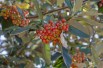
Fruits: Small red to orange berries, ripening September–October, eaten by birds
Wildlife value: Melliferous, attracts bees and butterflies; fruits feed birds and small mammals
Exposure: Sun or partial shade
Soil type: Calcareous, dry or poor, well-drained
Soil nature: Neutral to calcareous, dry to fresh
Preparation: Loosen soil, remove large stones, add compost if soil is poor
Spacing: 5–6 m
How to plant: Container-grown plants can be planted year-round outside frost and heat; water well and mulch
At planting: Regular watering to encourage rooting
At maturity: Low needs; drought tolerant once established
When/how: Light winter pruning, remove dead wood or awkward branches, maintain natural shape
Methods: Seed after stratification, semi-woody cuttings, grafting onto Sorbus rootstocks
Placement: Solitary specimen, avenue planting, free hedge
Associations: Mountain conifers, field maple, hawthorn, blackthorn
Traditional uses: Fruits used in folk medicine for astringent properties; wood used in crafts
Sensitivities: Susceptible to fire blight and leaf spots
Prevention: Avoid excess humidity, encourage plant diversity, natural horsetail decoctions
Choose a sunny site, calcareous or well-drained soil, limit watering once established. Light pruning to maintain shape, combine with native species to enhance biodiversity.
The Whitebeam (Sorbus aria) is distinguished by its silvery leaf underside, decorative red fruits, and tolerance of calcareous dry soils.
The Whitebeam (Sorbus aria) is a hardy ornamental tree valued for its silvery foliage and decorative red fruits. Native to European mountains, it thrives in calcareous and dry soils, making it ideal for challenging gardens. Its flowering attracts bees and butterflies, while its fruits feed birds and small mammals, enhancing biodiversity. Easy to grow and maintain, it keeps a rounded crown without heavy pruning. Traditionally, its fruits were used in folk medicine and its wood in crafts. This tree combines aesthetic appeal, ecological value, and tradition, enriching landscapes with natural elegance and resilience.
Shipping & delivery
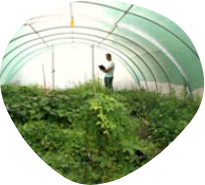 As soon as you place your order your plants are selected
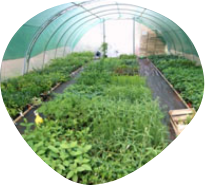 Each order is processed individually.
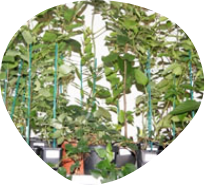 Plants are packed, staked and labeled.
 Packaging is carefully implemented to avoid any problems.
 Packages are ready to be shipped.
We ship our plants throughout Europe (excluding overseas territories and islands).
Avis clients


The Whitebeam is a hardy ornamental tree with silvery foliage and red fruits, ideal for calcareous dry gardens.
Your cart is empty
Continue shopping