- New




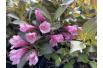
Dwarf Weigela 'Foliis Purpureis' is a compact shrub prized for the changing colors of its foliage throughout the year. Its small size makes it ideal for borders and small spaces. In spring, its dense shape is covered in bright pink to purplish-pink flowers, creating a striking contrast with its dark foliage. It is an extremely hardy and easy-to-grow variety, adapting to most soils in our region.
Description
The Dwarf Weigelia Foliis Purpureis is a premier choice for landscapes requiring low-growing plants with strong visual interest. This cultivar stands out for the continuous metamorphosis of its leaves, offering a color palette that evolves from deep purple to orange-red throughout the seasons. Its spring flowering, ranging from bright pink to purplish-pink, is particularly generous and covers a large part of its compact branches. Due to its reduced dimensions, it allows for structuring the front of borders or creating low hedges without requiring repetitive pruning. Its extreme frost resistance makes it a reliable shrub, capable of enduring harsh winters without structural damage.
The species type is native to East Asia, thriving naturally in the valleys and forest edges of China, Korea, and Japan. The 'Foliis Purpureis' selection was developed in Europe to stabilize the dwarf habit and dark foliage coloration. Its robustness quickly justified its use in parks and gardens across temperate regions worldwide.
This Weigelia belongs to the Caprifoliaceae family, a group that includes well-known flowering ornamental shrubs such as honeysuckles and snowberries. Plants within this group generally share opposite leaves and flower buds clustered at the branch nodes. This lineage guarantees a good tolerance to various soils and a predictable spring bloom.
The variety name, Foliis Purpureis, literally translates from Latin as "with purple leaves," highlighting its primary characteristic. Botanically, the dark pigmentation of the leaves is caused by a high concentration of anthocyanins, which protect plant tissues against intense solar radiation. This feature enhances its overall resilience and reduces the risk of foliage fading in mid-summer.
At maturity, this dwarf Weigelia stabilizes its height between 0.80 and 1 meter. This measured development classifies it among small-sized shrubs, perfect for restricted spaces. It reaches this size in just a few years and maintains a stable profile thereafter.
The spread of the branches varies from 1 to 1.50 meters in diameter at adulthood. The shrub tends to grow slightly wider than it is tall, giving it a solid base. This spread allows it to cover the ground effectively, forming a dense dome.
The habit is typically compact and bushy, with short branches dividing right from the base of the crown. Its structure is tight, leaving few gaps in the center of the plant. This stocky appearance ensures excellent stability against adverse weather and the weight of snow in winter.
The bark of the twigs is a matte greyish-brown, thin and smooth on young wood. As it ages, it takes on a slightly rougher texture and darkens subtly without ever peeling. It remains inconspicuous under the foliage, serving as a neutral support for the changing colors of the shrub.
The deciduous foliage is remarkable: the young spring growth emerges dark purple, evolves to a purplish-bronze in summer, then turns orange-red in autumn before falling. The leaves are oval, pointed, and finely serrated along the margins. This succession of shades ensures visual interest over more than three seasons.
The growth rate is moderate, as the shrub directs its energy into densifying its branches rather than excessive lengthening. New annual shoots are short but sturdy, guaranteeing the natural compactness of the bush. This regularity simplifies its integration into garden designs.
This cultivar displays outstanding hardiness, resisting temperatures down to -29°C (-20°F). Severe winters and prolonged frosts do not affect the vigor of its buds. It is therefore perfectly adapted to mountain zones and harsh continental climates.
The main and abundant flowering takes place during May and June, marking the transition between spring and summer.
The flowers are small bells of a bright pink to purplish-pink color, gathered in short, dense clusters along the stems. The vivid color of the corolla creates a stark contrast against the dark background of the purple foliage. They open gradually, extending the colorful impact over several weeks.
Fruiting takes the form of leather-like brown capsules that mature in autumn. These capsules split open at full maturity to release very fine seeds. They carry no decorative value and remain attached to the bare twigs during part of the winter.
The small bells produce accessible nectar that actively attracts bees, bumblebees, and butterflies in spring. The dense, low structure of the shrub provides a valued shelter for beneficial ground fauna, such as ground beetles. It is a wise choice for enriching biodiversity in urban and suburban gardens.
To fully express the purple coloration of its foliage, this shrub requires a position in full sun. Intense light is necessary to activate the synthesis of dark pigments in the leaves. Installation in partial shade remains possible, but the foliage will tend to turn green and flowering will be less profuse.
The soil should be loosened over a volume twice that of the root ball to facilitate the development of fine roots. Incorporating an organic amendment like well-decomposed compost enriches the soil and improves its structure. Because our plants are produced in pots, the roots experience no stress, allowing for planting year-round except during frosts or extreme drought.
When creating a border or a low ground cover, maintain a distance of 0.80 to 1 meter between each plant. This spacing allows the plants to merge quickly into a continuous vegetative mass. For solitary planting, leave a free space of 1.50 meters around the subject.
This Weigelia thrives best in loose, fertile, and moist soils, ranging from neutral to moderately alkaline. It tolerates clay soils provided they do not become waterlogged in winter. It is essential to avoid purely sandy soils that dry out too quickly in summer.
Submerge the root ball in water until fully saturated before positioning it in the planting hole. The top of the root ball should sit level with the ground surface. Fill in with soil, press down firmly around the collar with your hands, and then carry out a first copious watering. An organic mulch is recommended to limit water evaporation.
Regular and generous watering is indispensable during the year following planting, at a rate of once or twice a week in summer. This constant moisture secures the anchoring of the root system into the surrounding soil. The plant signals a lack of water by a temporary drooping of its young shoots.
Once established, the shrub manages dry spells better due to its dense root network. However, to maintain healthy foliage and prevent premature leaf drop in summer, supplemental watering is necessary during prolonged drought. Maintaining moist soil also guarantees a more vibrant autumn coloration.
Pruning takes place right after flowering, in July, since the flowers appear on the wood of the previous year. The operation consists of shortening the spent flowering stems by half to encourage the growth of new, vigorous shoots that will bloom next year. Also, remove dead wood and thin the center of the bush if necessary. Due to the compact habit of this dwarf variety, a light trim is more than enough to maintain its balanced silhouette.
The propagation of this cultivar is mainly done via semi-ripe cuttings at the end of summer or softwood cuttings in June. Cuttings should be placed in a humid, light soil mix under cover to promote root formation. Sowing seeds is proscribed because it does not faithfully transmit the color and size characteristics of the parent plant.
Due to its compact development, this Weigelia is perfect for designing low borders, fresh rock gardens, or the front of taller shrub beds. It pairs beautifully with perennials featuring grey or golden foliage that highlight its purple hue. Its changing coloration also makes it an excellent choice for adding rhythm to small urban gardens.
The Dwarf Weigelia 'Foliis Purpureis' displays excellent natural resistance against common fungal diseases. Aphids may occasionally colonize the tips of young shoots in spring, but infestations remain limited and harmless to the shrub. Slugs can sometimes nibble the low leaves on young plants, so monitoring after planting is recommended.
An annual application of organic matter or a complete organic fertilizer in early spring stimulates growth and flower bud formation. ensure the mulch at the base is maintained to protect the shallow root system from summer heat. Avoid late pruning in autumn or winter, as this risks removing all of the following spring's bloom.
Shipping & delivery
 As soon as you place your order your plants are selected
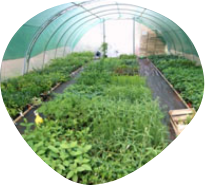 Each order is processed individually.
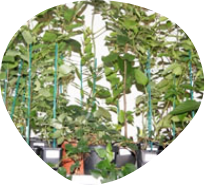 Plants are packed, staked and labeled.
 Packaging is carefully implemented to avoid any problems.
 Packages are ready to be shipped.
Expédition de nos plantes dans toute l'Europe (sauf en outre mer et les îles).
Avis clients


Dwarf Weigela 'Foliis Purpureis' is a compact shrub prized for the changing colors of its foliage throughout the year. Its small size makes it ideal for borders and small spaces. In spring, its dense shape is covered in bright pink to purplish-pink flowers, creating a striking contrast with its dark foliage. It is an extremely hardy and easy-to-grow variety, adapting to most soils in our region.
Your cart is empty
Continue shopping