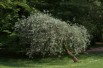
Weeping willow-leaved pear – Pyrus salicifolia ‘Pendula’
Main features
The Weeping willow-leaved pear (Pyrus salicifolia ‘Pendula’) is a highly ornamental small tree, prized for its distinctly pendulous habit, narrow silvery foliage, and bright spring blossom.
It forms a graceful, flowing silhouette, reminiscent of a small weeping willow, while retaining the strength and resilience typical of wild pears.
Perfectly suited to modern, Mediterranean and natural-style gardens, it offers year-round structure with minimal maintenance requirements.
Origin and botanical characteristics
Pyrus salicifolia originates from the Caucasus, Asia Minor and the Middle East, where it naturally grows on dry, stony and calcareous soils.
The cultivar ‘Pendula’ was selected for its strongly weeping branches, providing immediate ornamental appeal.
This deciduous tree features:
- an average height of 5–6 metres, with similar spread;
- a short trunk, topped by long, arching and drooping branches;
- grey-brown bark, becoming slightly fissured with age.
Its most striking feature is the very narrow, willow-like foliage, covered with a fine silvery down that reflects light beautifully.
Flowering and fruiting
In spring, usually in May, the tree is covered with numerous small white flowers, lightly scented and highly attractive to pollinators.
The blossoms appear on still-bare branches, creating a fresh and luminous display.
After flowering, small round pears develop.
Although edible, they are hard and of limited flavour, but they add decorative interest and may feed birds later in the season.
Foliage and ornamental value
The foliage of Pyrus salicifolia ‘Pendula’ is one of its main assets.
The slender, lance-shaped leaves emerge silvery, turn grey-green in summer, and retain a soft, satiny sheen.
In autumn, they take on pale yellow to golden tones before falling, revealing the elegant weeping framework.
Even in winter, the tree remains highly decorative thanks to its flowing branch structure.
Exposure and soil
This ornamental pear thrives in full sun, essential for intense leaf colour and abundant flowering.
It is extremely tolerant of soil conditions:
- dry or stony soils,
- calcareous ground,
- poor or shallow substrates.
It dislikes waterlogged conditions.
Once established, it is highly drought-tolerant and hardy down to –24 °C.
Planting and maintenance
Plant in, ensuring good drainage.
Regular watering is recommended during the first two years; afterwards, the tree becomes largely self-sufficient.
Pruning is optional, carried out in winter to:
- enhance the weeping habit,
- remove dead or poorly positioned branches.
A very low-maintenance tree, with good natural disease resistance.
Garden use
The Weeping willow-leaved pear is ideal:
- as a specimen tree,
- in modern or Mediterranean landscapes,
- near terraces or water features,
- in urban settings, thanks to pollution tolerance.
It pairs beautifully with ornamental grasses, lavender, Japanese maples or dark-leaved shrubs.
Potential problems and diseases
Pyrus salicifolia ‘Pendula’ is generally very healthy.
In unfavourable conditions, it may be affected by fire blight, but it is much less susceptible than fruiting pear trees.
Good air circulation and sun exposure minimise any risk.
The Weeping willow-leaved pear (Pyrus salicifolia ‘Pendula’) is a sculptural, light-filled ornamental tree.
Its silver foliage, white spring flowers and flowing weeping habit provide year-round interest.
Hardy, drought-tolerant and easy to grow, it is perfectly suited to modern and Mediterranean-style gardens.



 As soon as you place your order your plants are selected
 Each order is processed individually.
 Plants are packed, staked and labeled.
 Packaging is carefully implemented to avoid any problems.
 Packages are ready to be shipped.