- New




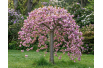
Prunus serrulata 'Kiku-Shidare-Zakura' is one of the most spectacular Japanese flowering cherries, celebrated for its unique weeping architecture and exceptionally dense spring display. Its long, flexible branches cascade elegantly to the ground, smothered in spring with an abundance of vibrant pink, fully double blossoms.
Description
The primary interest of Cheal's Weeping Cherry 'Kiku-Shidare-Zakura' lies in its striking landscape architecture. Its pendulous habit, combined with spring blossoms that are among the most double and colorful within the Prunus genus, creates a powerful focal point. The branches cascade down to the ground, providing strong visual interest even in winter through its structured silhouette.
This horticultural variety originates from the famous Japanese ornamental cherries (Sato-Zakura), selected for centuries in Japan. Its Japanese name translates to "weeping cherry in the shape of a chrysanthemum," referencing the densely double structure of the blossoms.
It belongs to the Rosaceae family and the genus Prunus. Its biology is typical of Asian flowering cherries, characterized by intense spring floral development concentrated on the wood produced during the previous year.
At maturity, its height stabilizes around 3.50 meters. This measurement depends heavily on the initial grafting height, as the weeping canopy dome rises slightly before cascading downwards.
The spread of the canopy reaches approximately 3 meters at maturity. The tree develops a compact umbrella shape, making its diameter perfectly manageable in smaller gardens.
Its habit is strictly weeping and pendulous. The main branches arch naturally from the graft union, and secondary twigs cascade vertically toward the ground, creating a dense plant curtain effect.
The bark of the trunk and main branches is a shiny chestnut-brown and smooth, with the characteristic horizontal lenticels of cherry trees. Young shoots are flexible, smooth, and bear a slightly copper tint.
Its deciduous leaves are alternate, ovate-lanceolate, and finely serrate. They emerge with a bronze-copper tint in spring, turn mid-green in summer, and transition to beautiful yellow-orange and copper tones in autumn before dropping.
The growth rate is moderate. Young twigs elongate rapidly during the spring and summer growing season, while the overall canopy structure achieves its definitive volume within a few years.
Showing excellent behavior against freezing, this variety is hardy down to -25 °C. The woody structures tolerate severe winters well, though advanced flower buds may be sensitive to exceptional late spring frosts.
The flowering unfolds spectacularly between April and May. It lasts for about two to three weeks, literally transforming the tree into a pink waterfall.
The flowers are densely double (up to 50 petals), measuring about 4 cm in diameter, and display an intense bright pink color. Held in dense, pendulous clusters, they bloom just before or simultaneously with the appearance of the first leaves, covering the entire length of the stems.
As this cultivar was selected for double flowers, it is sterile. It produces little to no fruit, which is ideal as it avoids dropping debris onto terraces or lawns.
Although double flowers limit pollen access for insects, the early bloom provides a sheltered structure for small garden wildlife in early spring.
It requires a position in full sun. Maximum light is essential to promote a high flower bud count, intensify the pink coloration of the petals, and ensure optimal autumn foliage colors.
The soil must be loosened deeply over a wide perimeter to encourage the root system of the rootstock to spread. An application of well-decomposed compost improves soil structure without creating excess nitrogen.
It is advisable to allow a clear space of at least a 3-meter radius around the trunk. Its weeping cascading habit requires space to develop without being compressed by neighboring plants.
It adapts to a wide range of soils but prefers rich, moist, deep, and well-drained ground. It dislikes heavy, waterlogged clay or excessively calcareous soils that induce chlorosis.
Dig a pit two to three times wider than the root ball. Install a sturdy stake to keep the trunk straight during the first few years. Place the tree, ensuring the root flare is level with the soil surface, backfill, firm gently, and water thoroughly.
Regular and abundant watering during the first two summers after planting is necessary. The soil must remain uniformly moist to support the development of the weeping canopy.
Once established, the root system is reasonably self-sufficient. However, supplemental watering during prolonged summer heatwaves helps maintain foliage vitality and guarantees bud formation for the following year.
Since flower buds form exclusively on the wood produced during the previous year, pruning must be carried out immediately after flowering. It is recommended to shorten the cascading branches by about one-quarter of their length, cutting cleanly just above a vigorous, outward-facing bud. This intervention stimulates the rapid growth of new, long, flexible shoots from the upper part of the canopy, ensuring the flower cascade for the following year.
Excellent as a specimen plant on a lawn, near a terrace, or close to a water feature where its weeping silhouette can reflect in the water. Due to its contained size, it is also highly suited for compact urban gardens.
Like many Prunus, it can be susceptible to blossom wilt (monilia) or silver leaf disease. Pruning with clean, disinfected tools and clearing fallen leaves in autumn significantly reduce these risks.
An organic mulch applied in spring helps maintain soil moisture. Systematically remove any suckers or wild growth appearing along the trunk or from the base of the rootstock to direct all energy to the weeping canopy.
Shipping & delivery
 As soon as you place your order your plants are selected
 Each order is processed individually.
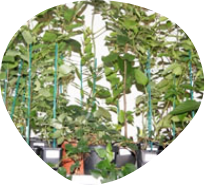 Plants are packed, staked and labeled.
 Packaging is carefully implemented to avoid any problems.
 Packages are ready to be shipped.
We ship our plants throughout Europe (excluding overseas territories and islands).
Avis clients




Prunus serrulata 'Kiku-Shidare-Zakura' is one of the most spectacular Japanese flowering cherries, celebrated for its unique weeping architecture and exceptionally dense spring display. Its long, flexible branches cascade elegantly to the ground, smothered in spring with an abundance of vibrant pink, fully double blossoms.
Your cart is empty
Continue shopping