- New



Malus domestica 'Reinette Blanche du Canada' (often simply called Reinette du Canada) is a true classic of traditional orchards. Despite its name, this ancient variety is typically European and remains essential due to the exceptional quality of its fruit, which is delicious both eaten fresh and used in cooking. Grown on an MM111 rootstock, this tree offers excellent vigor, great robustness, and a controlled height of 3 meters, ideal for today's gardens.
Description
The major appeal of 'Reinette Blanche du Canada' lies in its absolute culinary versatility and its remarkable storage capacity. Excellent for fresh eating, it is also the ultimate cooking apple, particularly outstanding when baked, where its flesh becomes deliciously melting and caramelised. Its generous productivity and strong overall resistance make it a reliable choice for any lover of authentic fruit.
Choosing the MM111 rootstock is a strategic advantage for growing this variety. From my experience as a nurseryman, it adapts remarkably well to clay soils, loamy soils, and even moderately heavy and compact soils, while tolerating summer drought very well thanks to a deep and powerful root system. Among its many qualities, MM111 provides the tree with semi‑standard vigour, ensures excellent anchorage (making staking unnecessary after a few years), and offers natural immunity to woolly apple aphid. It also promotes earlier fruiting than seedling rootstocks while ensuring excellent longevity.
Contrary to what its name suggests, this variety originates from France, probably from Anjou or Normandy, where it has been cultivated and documented since the late 18th century. The term “du Canada” historically referred to its introduction or to a prestigious designation of the time.
The apple tree belongs to the Rosaceae family and to the species Malus domestica. 'Reinette Blanche du Canada' is a triploid variety, meaning its pollen is sterile and it cannot pollinate other apple trees.
At maturity, the tree reaches a stable height of about 3 metres. This compact size allows for easy maintenance and harvesting at human height, without the need for large ladders.
Its spread ranges between 2.5 and 3 metres, forming a compact and well‑balanced crown.
The growth habit is spreading to slightly weeping. Initially vigorous and upright, the tree quickly opens under the weight of the first harvests, with branches arching elegantly towards the ground.
The bark is grey‑brown, becoming slightly scaly and rough on older specimens, reflecting its strength and health.
The deciduous leaves are large, oval‑rounded, dark matte green on the upper side and slightly pubescent (downy) on the underside, with distinctly serrated margins.
Growth is rapid during the first years, then slows significantly once the tree enters its fruiting phase.
Exceptionally robust, this tree withstands winter temperatures down to -25 °C, adapting perfectly to harsh climates.
Flowering occurs in mid‑season (April–May). It is abundant and composed of clusters of very attractive white‑pink blossoms.
The flowers are simple, with five petals, opening from deep pink buds into pure, bright white blooms. They are highly attractive to bees and other pollinating insects.
As 'Reinette Blanche du Canada' is triploid, it absolutely requires the presence of at least one (ideally two) compatible apple varieties nearby to ensure fruiting. The best pollinators are:
Cox's Orange, Court Pendu Rouge, Golden Delicious, Granny Smith, Idared, Reinette Étoilée, Reine des Reinettes. And the ornamental crabapples Golden Hornet and John Downie.
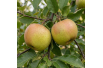
The fruit is large to very large, irregular in shape, globular, often asymmetrical and slightly ribbed. The skin is initially green‑yellow, turning golden yellow at maturity. It is thin but rough, characterised by a strong presence of russeting (a greyish, corky, russet appearance) over much of its surface, giving it its rustic charm. The flesh is greenish‑white to yellowish, fine, dense, tender and crisp. It is very juicy, tart, and endowed with a pronounced, musky reinette aroma, highly typical and sought after.
Harvest takes place during October. This is a long‑keeping apple that benefits greatly from cellar storage, where it improves to reach full flavour from December onwards and keeps easily until March.
The apple tree prefers a full sun position or, at most, light partial shade. Sunlight is essential for colouring the skin and concentrating sugars in the fruit.
Allow 3 to 4 metres between trees to ensure maximum sunlight and good air circulation.
It thrives in rich, deep, fresh but well‑drained soils. Although it tolerates heavy soils, it dislikes extremes: constantly waterlogged soils or purely dry sandy soils.
Dig a wide hole (80x80 cm), mix quality potting soil or mature compost with the original soil. Place the tree ensuring the graft union remains above soil level. Firm the soil, form a watering basin and water generously.
Monitor watering carefully during the first two summers (one good bucket per week in case of drought). Once established, its needs become moderate and limited to prolonged heatwaves.
Pruning 'Reinette Blanche du Canada' requires particular attention due to its strong initial vigour and spreading habit. As a nurseryman, my experience leads me to recommend a two‑step approach:
Training pruning (first 3 years): Remove branches crossing towards the inside of the crown to promote an open goblet structure. Balance the main branches to prevent the tree from leaning to one side.
Fruiting pruning (in winter, frost‑free): this variety produces many fruits on spurs and 2‑ to 3‑year‑old wood. Thin regularly by removing dead wood and vertical suckers that exhaust the tree. Slightly shorten drooping shoots to stimulate new flower buds closer to the main branches. Fruit thinning in June (leaving only one or two fruits per cluster) is strongly recommended to avoid biennial bearing and ensure generous fruit size.
The variety is naturally cold‑resistant but may be susceptible to scab in very humid climates. Airy pruning and collecting fallen leaves in autumn are usually enough to keep the tree in excellent health.
Why does my Reinette du Canada produce many fruits one year and almost none the next? This is the biennial bearing phenomenon, common in this vigorous variety. To avoid it, you must thin the fruits in June, leaving only one or two per cluster. This relieves the tree and allows it to prepare flower buds for the following year.
Can Reinette Blanche du Canada pollinate other apple trees in my orchard? No. It is a triploid variety, meaning its pollen is sterile. It must be pollinated by other varieties (such as 'Idared' or 'Golden Delicious'), but it cannot act as a pollinator itself.
The skin of my apples is rough with russet patches, is this a disease? Not at all. This phenomenon is called russeting. It is completely natural and one of the main visual characteristics of 'Reinette Blanche du Canada'. It does not affect the flesh quality; in fact, it often protects the fruit.
What is the best culinary use for this apple? Although delicious fresh for lovers of tart apples, it is the absolute queen of baked apple recipes. Its fine, dense flesh holds perfectly during cooking while becoming melting and intensely aromatic.
Can Reinette du Canada be eaten immediately after harvest in October? It is edible but will be very firm and acidic. As a true storage apple, it greatly improves after a few weeks in a cellar. Its full flavour is reached between December and March, when its sugars have concentrated.
Shipping & delivery
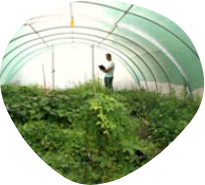 As soon as you place your order your plants are selected
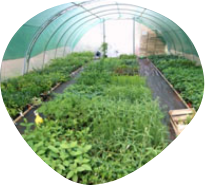 Each order is processed individually.
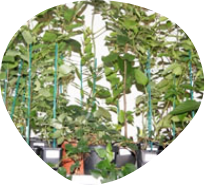 Plants are packed, staked and labeled.
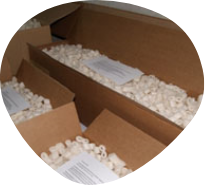 Packaging is carefully implemented to avoid any problems.
 Packages are ready to be shipped.
We ship our plants throughout Europe (excluding overseas territories and islands).
Avis clients


Malus domestica 'Reinette Blanche du Canada' (often simply called Reinette du Canada) is a true classic of traditional orchards. Despite its name, this ancient variety is typically European and remains essential due to the exceptional quality of its fruit, which is delicious both eaten fresh and used in cooking. Grown on an MM111 rootstock, this tree offers excellent vigor, great robustness, and a controlled height of 3 meters, ideal for today's gardens.
Your cart is empty
Continue shopping