- New



The 'Red No.2' Mulberry, a premium choice resulting from rigorous hybridizations, is valued for the excellent taste balance of its fruits. More precocious than the wild type, it offers generous mulberries ideal for amateur orchards.
Description
The major interest of the 'Red No.2' Mulberry lies in the excellence of its aromatic profile and its faster fruiting compared to traditional mulberry seedlings. By combining the qualities of two distinct species, this cultivar is free from the blandness sometimes blamed on certain white mulberries, while still offering regular productivity in a temperate climate. It is an excellent compromise for the gardener looking for a medium-development tree, capable of providing tasty summer harvests from the very first years of planting.
The 'Red No.2' is the result of selection work (seedling selection) originating from hybridization programs carried out in Central and Temperate Europe. It was isolated for its production regularity during changing summers, which are typical of northern and western European climates.
This cultivar is a direct hybrid or a crossbreed between the American red mulberry (Morus rubra) and the white mulberry (Morus alba). Botanically, it combines the richness in sugars and tolerance to varied soils of Morus alba with the superior taste fineness, pronounced perfume and deep color characteristic of Morus rubra. Like all Moraceae, its branches contain a sticky white latex that serves as a natural healing barrier against wounds.
The 'Red No.2' shows a flexible wood structure and good branching capacity. Its fruiting is not simultaneous, which avoids the occurrence of a sudden overload on the structural branches and allows the maturity of the fruits to be spread over several weeks.
At maturity, its height generally stabilizes between 3.50 and 5 meters. Its vigor naturally diminishes as soon as the tree enters the regular production phase, which allows it to be easily maintained at an orchard size by an annual maintenance pruning.
The spread of its canopy varies between 3 and 4 meters. Its crown forms a dome widening with age, which requires a clear space to be provided for it.
Its habit is rounded, spreading and slightly weeping at the extremity of young branches under the effect of the weight of the leaves and fruits in summer.
The bark is a textured grey-brown, cracking vertically with the years to reveal slightly orange tints at the bottom of the furrows.
The deciduous foliage is highly heterogeneous (polymorphous). One and the same branch can bear unlobed, oval and heart-shaped leaves, as well as deeply lobed leaves. Clear green in season, they turn yellow in autumn before falling. Their texture remains supple, typical of Morus rubra hybrids.
Growth is sustained during the tree's youth (shoots of 60 to 80 cm per year under optimal conditions), then slows down significantly once fruiting stabilizes.
This cultivar tolerates winter frosts of the order of -25 °C. Young spring shoots can be sensitive to late frosts if budding is early, but the tree has a good capacity to emit replacement buds.
Flowering takes place in May, in the form of small discrete catkins appearing at the same time as the first leaves.
Male and female flowers are borne by the same specimen. The 'Red No.2' is self-fertile; pollination is ensured by the wind, requiring no proximity to another tree to bear fruit.
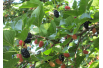
The fruit is an elongated compound fruit (sorosis) measuring 2 to 2.5 cm long. Passing from green to red, it reaches its full maturity when it sports a dark purple to almost black hue. The taste of the fruit is its true added value: the pulp is tender, very juicy and offers a rich flavor where the sweetness of the white mulberry is enhanced by the fruity acidity and wild berry aromas inherited from the red mulberry. The harvest extends from July to the end of August.
Fruits that have become overripe and fallen to the ground are a treat for birds and auxiliary insects at the end of summer.
The 'Red No.2' requires an exposure in full sun to guarantee the development of sugars in the fruit and a homogeneous coloration of the harvest.
Deep soil loosening is recommended to facilitate the anchoring of the taproot system. An input of well-decomposed compost helps recovery. Since our plants are grown in containers, planting can be carried out without trouble throughout the year, excluding periods of severe frost or prolonged drought.
Provide a space with a 4-meter radius relative to other trees or infrastructures to allow it to develop its canopy symmetrically.
It adapts to neutral, loamy, sandy or clay-limestone soils, provided they are deep and correctly drained. It fears compact soils where water stagnates during winter.
Dig a hole equivalent to twice the volume of the root ball. If your soil retains water, place a draining layer at the bottom of the hole. Install the plant, fill with garden soil enriched with a planting compost, pack without excess, arrange a basin for watering and mulch.
Regular and generous waterings during the first summer are necessary to support deep rooting (an input every 10 to 12 days in dry periods).
Once its root system is installed, it is autonomous. However, a prolonged lack of water in July can impact juiciness and cause part of the fruits to shrivel before their complete maturity.
Pruning is practiced in winter (January-February), during the complete rest period of the vegetation. It consists of removing dead wood, aerating the center of the branch structure to optimize sun exposure and limiting the excessive elongation of the main branches to facilitate access to the fruits.
This cultivar multiplies faithfully by grafting (cleft or rind graft) on Morus alba rootstock, or by taking semi-hardwood cuttings in summer under controlled conditions.
It is mainly used as a specimen plant in a medium-sized garden, at the back of a border or integrated into a free fruiting hedge.
The 'Red No.2' mulberry is a tree naturally resistant to diseases. Its main constraint remains competition from birds, which enjoy the fruits as soon as they turn red.
Avoid massive inputs of chemical nitrogen fertilizers which promote the growth of soft wood at the expense of fruiting. An annual input of matured compost or well-decomposed manure in autumn is sufficient to maintain soil fertility. A regular organic mulching preserves soil coolness in summer.
Shipping & delivery
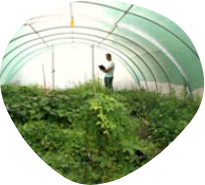 As soon as you place your order your plants are selected
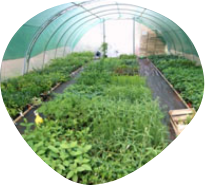 Each order is processed individually.
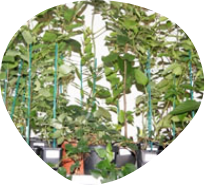 Plants are packed, staked and labeled.
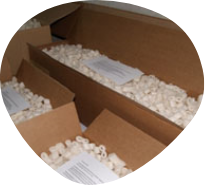 Packaging is carefully implemented to avoid any problems.
 Packages are ready to be shipped.
Expédition de nos plantes dans toute l'Europe (sauf en outre mer et les îles).
Avis clients


The 'Red No.2' Mulberry, a premium choice resulting from rigorous hybridizations, is valued for the excellent taste balance of its fruits. More precocious than the wild type, it offers generous mulberries ideal for amateur orchards.
Your cart is empty
Continue shopping