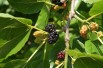
Black Mulberry, Morus nigra
Main Interest
The Black Mulberry (or Morus nigra) is far more than a simple fruit tree; it is a true historical and culinary monument in the garden. Unlike the white mulberry (Morus alba), often planted for silkworm rearing or as a fast-growing street tree, the black mulberry is revered by connoisseurs for the exceptional quality of its fruit. It is a tree of character, often described as a "patriarch" due to its slow growth and a silhouette that becomes picturesque and gnarled with age.
Its main interest undoubtedly lies in its fruit, the mulberries, which offer a perfect and rare balance between sweetness and acidity, a rich flavor that blackberries or white mulberry fruits fail to equal. Beyond the harvest, it is a first-rate ornamental tree for medium to large gardens. Its dense, dark foliage provides thick, beneficial shade in summer, creating a highly appreciated cool microclimate. In permaculture or fruit gardens, it is a sustainable choice, capable of living for centuries, resistant to diseases, and requiring few inputs once established. Planting a Morus nigra means choosing authenticity and patience for an unmatched taste reward.
Origins and Characteristics
Geographical Origin:
This species originates from the mountainous and temperate regions of Western Asia, specifically Iran, Armenia, and the Caucasus. It was introduced to Europe in antiquity, long before the white mulberry, appreciated by the Greeks and Romans for its delicious fruit.
Botanical Family:
It belongs to the Moraceae family, a family that also includes figs (Ficus). This family is characterized by the presence of latex in the tissues and often by fleshy compound fruits.
Notable Features:
Historically, Morus nigra was often confused in ancient texts with the common bramble due to the resemblance of the fruits. It possesses a very high ploidy (number of chromosomes), which makes it genetically very stable: unlike other fruit trees, there are very few distinct varieties, with the species type itself constituting the reference cultivar for fruit quality.
Description and Particularities:
Mature Height
It is a tree of moderate but steady development. At full maturity, often after several decades, it can reach 10 to 12 meters in height. However, in garden culture, and especially if grafted, it is generally kept between 4 and 6 meters to facilitate harvesting.
Mature Width
The black mulberry tends to spread more than it grows tall. Its span is impressive and can often equal or even exceed its height. Expect a width of 6 to 10 meters for a very old, unpruned specimen, forming a true natural parasol.
Habit (General Shape)
Its habit is naturally spreading, stocky, and rounded. Over time, the main branches become massive and twisted, giving the tree a sculptural, almost architectural appearance, with a wide crown and flattened dome very characteristic of old specimens.
Bark (characteristics, color, particularities)
The bark is an aesthetic asset in winter. Orange-brown to grayish in color, it becomes rough, fissured, and knobby with age. It often presents ridges and deep cracks that testify to the slow growth and robustness of the trunk.
Foliage (type of foliage, color, seasonal changes)
The leaves are deciduous, alternate, and heart-shaped (cordate). They are distinguished from those of the white mulberry by their texture: they are thick, rough to the touch (pubescent) on the upper surface, and of a very dark, deep green. They turn yellow late in the autumn before falling.
Growth (growth rate)
The growth of Morus nigra is reputed to be slow, especially in its early years, which contrasts sharply with the explosive juvenile vigor of the white mulberry. It takes its time to establish its structure, which explains the hardness and quality of its wood.
Hardiness (temperature tolerance)
It is a very hardy tree once well-established. It withstands temperatures down to -20°C in drained soil. However, young specimens can be a bit more sensitive to late spring frosts and benefit from protection during the first two winters.
Flowering and Fruiting:
Flowering Period
Flowering is late, usually occurring in May or June. This lateness is a major asset as it allows the flowers to escape most spring frosts, thus guaranteeing regular fruiting even in northern regions.
Detailed Description of Flowers
The flowers are discreet, pale green to yellowish, and gathered in small hanging (for males) or ovoid (for females) catkins. The tree is generally monoecious (male and female flowers on the same tree) and self-fertile, requiring no companion to fruit.
Fruits (type and dispersal, taste and pollinator)
The fruit is a collective fruit composed of small agglomerated drupelets, resembling a large oblong blackberry. First green, then red, it becomes ebony black at maturity in summer (July-September). The taste is exceptional: very juicy, staining, with a perfect balance between sugary sweetness and refreshing acidity. The main pollinator is the wind.
Melliferous Characteristics or Wildlife Attraction
Although the flowers are little visited by bees (anemophilous pollination), the tree is a magnet for biodiversity thanks to its fruit. Birds (blackbirds, thrushes, starlings) love them. It is an excellent way to attract and feed local birdlife in late summer.
Exposure and Soil
Ideal Exposure:
Morus nigra requires a sunny and warm situation. It needs heat to ripen its fruits and develop its aromas. A south or west-facing exposure, sheltered from cold prevailing winds that could break its brittle branches, is perfect.
Adapted Soil Type (in detail):
It likes deep, loose, and well-drained soils. It dreads above all waterlogged soils in winter (root asphyxia). It tolerates limestone and dry soils well once established, but prefers loamy, rich, and humus-bearing earth for optimal fruit production.
Planting
Tips for Soil Preparation:
Work the soil deeply over a volume representing at least three times that of the pot. Loosen the bottom of the hole well (with a garden fork) to facilitate vertical rooting. Incorporate a good amount of mature compost or well-rotted manure into the extracted earth.
Spacing Between Plants:
Given its future spread, provide generous spacing. Leave 6 to 8 meters of distance between two trees or from a building. If space is limited, pruning will have to be rigorous to contain its crown.
Nature of the Soil:
The soil should ideally be neutral to slightly alkaline, although the tree tolerates slight acidity. It must above all be draining (stony or sandy is acceptable if enriched) and not heavy clay (compact) to avoid root rot.
How to Plant:
For our pot-grown plants, planting is possible all year round excluding frost and drought. Immerse the root ball in water until saturated. Place the root ball in the hole so that the graft point (if present) is well above the ground. Fill with the soil-compost mix, tamp moderately at the base, and form a watering basin.
Watering
Water Needs at Planting:
Immediately after planting, copious watering (20 to 30 liters) is essential to drive out air pockets, even if it is raining. During the first year, water regularly (once a week in summer), especially if the plant is installed in spring or summer.
Water Needs at Maturity:
Once its powerful root system is established (after 2-3 years), the black mulberry is very resistant to summer drought. It no longer requires watering, except in cases of exceptional prolonged heatwaves where a water supply will support fruit sizing and prevent premature drop.
Pruning
When and How to Prune:
Pruning must imperatively be done in late winter (February), before the sap rises, because the mulberry "bleeds" abundantly if pruned too late. Favor gentle pruning: remove dead wood, branches crossing in the center to aerate the crown ("light in the center"), and shorten overly long shoots. On low-stem grafted subjects, maintain the goblet shape to keep fruits accessible. Avoid large pruning wounds which heal poorly.
Multiplication
Possible Propagation Methods:
Morus nigra propagates with difficulty from seed (very slow growth, uncertain fidelity). The most common and reliable method is hardwood cuttings in winter or layering. Professionals prefer grafting (often on Morus alba for vigor) in spring, which ensures quicker fruiting.
Uses in the Garden
Ideal Location for the Plant:
Install it as an isolated specimen on a lawn to highlight its architecture, or at the back of an orchard. Warning: never plant it over a terrace, a paved path, or a parking area. Ripe fruits fall, get crushed, and stain floor coverings (and clothes!) strongly and permanently. A location on beaten earth or grass is ideal.
Recommended Plant Associations:
At the base of the tree, you can plant spring bulbs (daffodils) which will flower before the leaves appear. Comfrey (Symphytum officinale) is an excellent companion: it covers the ground, limits weeds, and once cut, serves as potassium-rich mulch beneficial for fruiting.
Traditional Uses
Description of Historical or Cultural Uses:
For centuries, the black mulberry has been cultivated for its fruits processed into syrups, jams, jellies, wines, and liqueurs. Mulberry syrup is a traditional remedy for sore throats and mouth inflammations. Its hard and dense wood was used in cabinet making and for making barrels, giving a yellow color to the wood upon aging.
Protection Against Diseases and Pests
Potential Sensitivities:
The black mulberry is a remarkably healthy and robust tree. It is little affected by parasites. It can sometimes be affected by bacterial blight (black spots on leaves and twigs) in very humid climates, or by scale insects (rarely serious). Its roots fear honey fungus if the soil is too wet.
Prevention Tips and Natural Treatments:
The best prevention is prophylactic: collect fallen leaves and rotten fruits from the ground in winter to avoid the survival of pathogens. In case of bacterial attack, treatment with Bordeaux mixture at leaf fall and spring bud burst is effective. Promote aeration of the branches through pruning.
Tips for Good Development
Practical Tips to Favor Good Development:
Be patient! The black mulberry takes a few years to settle before growing and fruiting abundantly. Do not over-fertilize with nitrogen, as this would favor foliage to the detriment of fruit and weaken it against frost. An annual supply of compost or wood ash (potassium) in autumn is ample for its well-being.
Differences and Specifics of the Cultivar
In the trade, the term "Black Mulberry" specifically designates the botanical species Morus nigra. This is in itself an old natural selection that is radically distinct from "black-fruited mulberries" which are often actually varieties of Morus alba (White Mulberry). The specificity of the true Black Mulberry is genetic (308 chromosomes versus 28 for the white). This translates concretely into:
-
Taste: Morus nigra possesses a complex acidity that gives "body" to the fruit, whereas Morus alba is flatly sweet.
-
Texture: The fruit of nigra is more fragile, juicier, and its skin is almost non-existent.
-
Leaf: It is rough and hairy underneath, unlike that of alba which is smooth and hairless.
-
Growth: Much slower and stockier than other species.
Summary of the Plant's Value
The black mulberry (Morus nigra) is a treasure for the patient and discerning gardener. Its main asset is culinary: it produces the most flavorful mulberries of its kind, combining sweetness and acidity in a juicy fruit reminiscent of wild berries. Ecologically, it is a valuable tree that feeds birds and, thanks to its large, dark foliage, provides a dense oasis of coolness in summer. Its gnarled silhouette and mature bark give it a highly decorative "old tree" aesthetic, instantly adding character to the garden. Hardy, undemanding, and very healthy, it only requires a sunny location away from patios to avoid staining them. It is the quintessential heirloom tree.



 As soon as you place your order your plants are selected
 Each order is processed individually.
 Plants are packed, staked and labeled.
 Packaging is carefully implemented to avoid any problems.
 Packages are ready to be shipped.